
- 2026-06-17
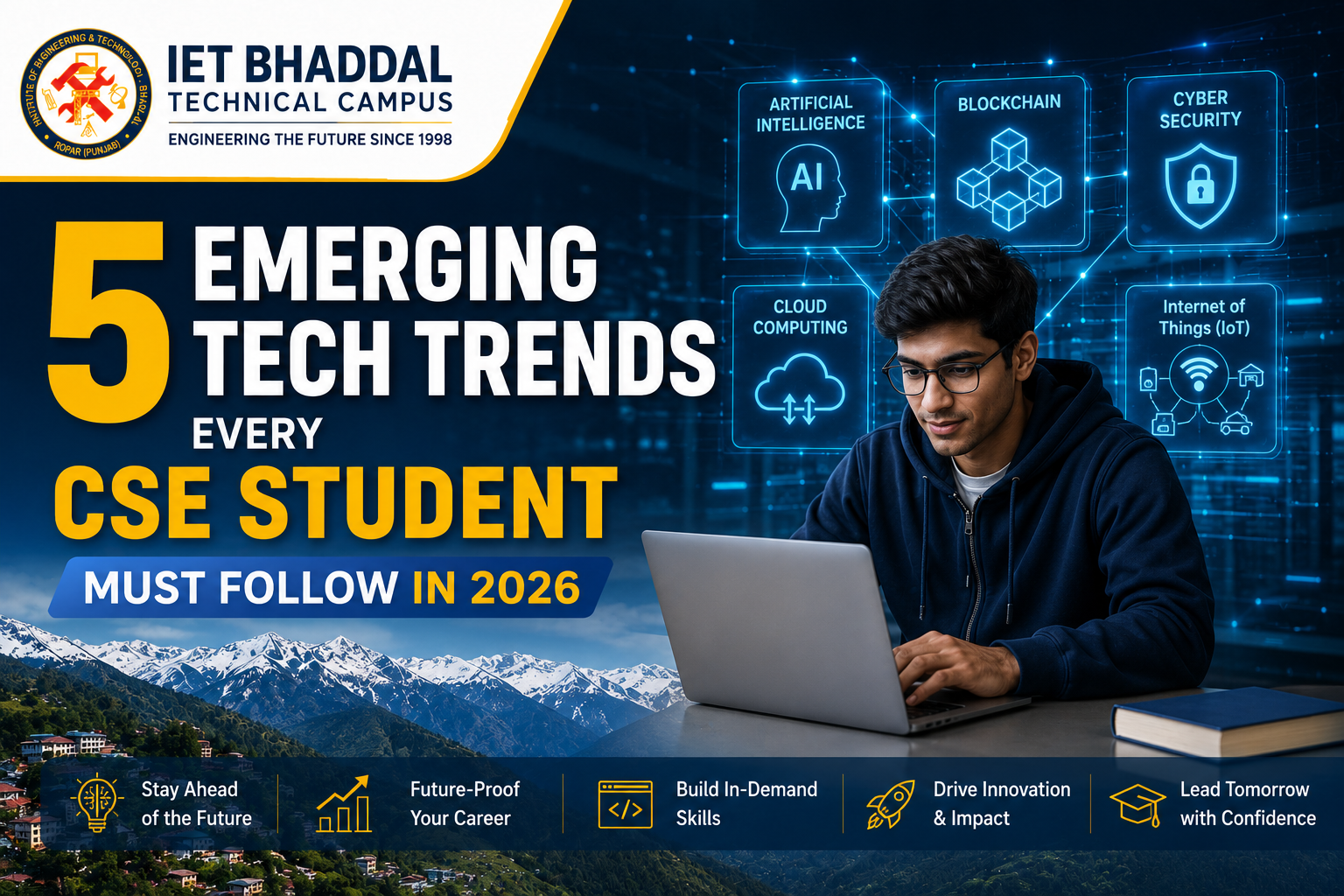
5 Emerging Tech Trends Every Computer Science Student Must Follow for a Successful Career in 2026
Desc - Discover the top 5 emerging technology trends shaping the future of Computer Science careers in 2026. Learn about AI, Cybersecurity, Cloud Computing, IoT, and Quantum Computing and prepare for a successful tech career.
5 Emerging Tech Trends Every CSE Student Must Follow in 2026
The technology industry is evolving at an unprecedented pace. Innovations that once seemed futuristic are now reshaping industries, creating new job roles, and redefining the skills employers seek. For Computer Science and Engineering (CSE) students, staying informed about emerging technologies is no longer an option—it's a necessity.
As businesses increasingly adopt intelligent systems, cloud platforms, automation tools, and advanced computing solutions, the demand for skilled technology professionals continues to grow. The graduates who thrive in 2026 and beyond will be those who combine strong technical fundamentals with expertise in emerging technologies.
Whether you aspire to become an AI Engineer, Cybersecurity Specialist, Cloud Architect, or Technology Entrepreneur, understanding future technology trends can help you make smarter career decisions and stay ahead of the competition.
Here are five game-changing technology trends every Computer Science student should follow closely to build a successful and future-ready career.
1. Artificial Intelligence (AI) and Generative AI: The Future of Intelligent Systems
Artificial Intelligence has moved beyond research labs and become a driving force behind modern innovation. From virtual assistants and recommendation engines to self-driving vehicles and intelligent chatbots, AI is transforming how businesses operate and how people interact with technology.
The emergence of Generative AI has accelerated this transformation even further. These advanced systems can generate text, images, code, videos, and business insights, making them valuable tools across nearly every industry.
Why CSE Students Should Care
Companies are actively hiring professionals who can develop, train, and deploy AI-powered solutions. AI skills are becoming essential not only for specialized AI roles but also for software development and product engineering positions.
Skills to Learn
-
Python Programming
-
Machine Learning
-
Deep Learning
-
Natural Language Processing (NLP)
-
Computer Vision
-
Prompt Engineering
-
TensorFlow and PyTorch
-
MLOps
Career Opportunities
-
AI Engineer
-
Machine Learning Engineer
-
Data Scientist
-
NLP Engineer
-
AI Research Associate
-
Generative AI Developer
Future Outlook: AI is expected to remain one of the highest-paying and fastest-growing technology domains throughout the coming decade.
2. Cybersecurity and Ethical Hacking: Protecting the Digital World
As organizations become more digitally connected, cyber threats continue to increase in scale and sophistication. Data breaches, ransomware attacks, phishing scams, and cloud vulnerabilities have made cybersecurity a top priority for businesses worldwide.
Cybersecurity professionals play a critical role in protecting digital assets, securing networks, and ensuring business continuity.
Why CSE Students Should Care
Every software application, website, cloud platform, and digital service requires strong security measures. Students with cybersecurity expertise are highly valued across industries.
Skills to Learn
-
Network Security
-
Ethical Hacking
-
Penetration Testing
-
Linux Administration
-
Cryptography
-
Security Auditing
-
Digital Forensics
-
Vulnerability Assessment
Career Opportunities
-
Cybersecurity Analyst
-
Ethical Hacker
-
Security Engineer
-
SOC Analyst
-
Information Security Consultant
-
Incident Response Specialist
Future Outlook: The global shortage of cybersecurity professionals continues to create excellent career opportunities for skilled graduates.
3. Cloud Computing and DevOps: The Backbone of Modern Software
Cloud Computing has fundamentally changed the way software applications are developed, deployed, and managed. Today, organizations rely on cloud platforms to deliver scalable, secure, and high-performance services to millions of users worldwide.
Alongside cloud adoption, DevOps practices have emerged as a key methodology for accelerating software delivery while improving reliability and efficiency.
Why CSE Students Should Care
Cloud technology is now integrated into nearly every software product and business application. Whether you pursue AI, software engineering, data science, or cybersecurity, cloud skills are becoming increasingly important.
Skills to Learn
-
Amazon Web Services (AWS)
-
Microsoft Azure
-
Google Cloud Platform (GCP)
-
Docker
-
Kubernetes
-
CI/CD Pipelines
-
Infrastructure as Code (IaC)
-
Terraform
Career Opportunities
-
Cloud Engineer
-
DevOps Engineer
-
Site Reliability Engineer (SRE)
-
Cloud Architect
-
Platform Engineer
-
Infrastructure Engineer
Future Outlook: Cloud-related jobs continue to dominate technology hiring trends due to the rapid growth of digital transformation initiatives.
4. Internet of Things (IoT) and Edge Computing: Building Smarter Connected Systems
The Internet of Things (IoT) is connecting billions of devices worldwide, creating intelligent ecosystems capable of collecting and exchanging real-time data. Smart homes, wearable devices, industrial automation systems, and smart cities are all powered by IoT technologies.
As connected devices generate massive amounts of data, Edge Computing has emerged as a solution for processing information closer to the source, reducing delays and improving efficiency.
Why CSE Students Should Care
IoT and Edge Computing are opening new opportunities in automation, healthcare, transportation, manufacturing, and smart infrastructure.
Skills to Learn
-
Embedded Systems
-
Sensor Integration
-
Microcontrollers
-
IoT Communication Protocols
-
Edge AI
-
Networking Fundamentals
-
Data Analytics
Career Opportunities
-
IoT Developer
-
Embedded Systems Engineer
-
Automation Engineer
-
Edge Computing Specialist
-
Robotics Engineer
-
Smart Systems Architect
Future Outlook: As industries embrace automation and smart technologies, demand for IoT professionals is expected to grow significantly.
5. Quantum Computing: The Next Technological Revolution
Quantum Computing is one of the most exciting frontiers in computer science. Unlike traditional computers that process information using binary bits, quantum computers use quantum bits (qubits), enabling them to solve certain complex problems far more efficiently.
Although still in its early stages, Quantum Computing has the potential to revolutionize industries such as pharmaceuticals, logistics, finance, cybersecurity, and scientific research.
Why CSE Students Should Care
Students who begin learning quantum concepts today can position themselves for future opportunities in one of the most advanced fields of computing.
Skills to Learn
-
Linear Algebra
-
Probability Theory
-
Quantum Algorithms
-
Quantum Programming
-
Research Methodology
-
Python Programming
-
Advanced Mathematics
Career Opportunities
-
Quantum Software Developer
-
Quantum Research Scientist
-
Research Engineer
-
Computational Scientist
-
Advanced Computing Specialist
Future Outlook: Quantum Computing is expected to create entirely new career paths as the technology matures over the next decade.
How CSE Students Can Prepare for the Future
Knowing about emerging technologies is important, but success comes from actively developing relevant skills and gaining practical experience.
Build Strong Fundamentals
Master core computer science subjects such as:
-
Data Structures and Algorithms
-
Operating Systems
-
Database Management Systems
-
Computer Networks
-
Software Engineering
A strong foundation makes it easier to adapt to new technologies throughout your career.
Work on Real-World Projects
Practical projects demonstrate your abilities far better than theoretical knowledge. Build applications, contribute to open-source projects, and create solutions that address real-world challenges.
Earn Industry Certifications
Certifications from leading technology platforms can strengthen your resume and improve employability.
Participate in Hackathons
Hackathons provide hands-on experience, encourage innovation, and help students develop teamwork and problem-solving skills.
Stay Updated
Follow technology blogs, attend webinars, participate in technical communities, and keep learning continuously. The most successful technology professionals are lifelong learners.
Why Future-Ready Education Matters
The rapidly evolving technology landscape requires educational institutions to go beyond traditional classroom learning. Students need access to practical training, industry exposure, research opportunities, innovation-driven projects, and skill-development programs.
At IET Bhaddal, students are encouraged to develop both technical expertise and professional skills through industry-focused learning experiences, helping them stay aligned with emerging technology trends and evolving industry demands. The institution's commitment to innovation, practical learning, and career readiness empowers students to confidently pursue opportunities in the technology-driven future.
Conclusion
The technology industry of 2026 will be shaped by Artificial Intelligence, Cybersecurity, Cloud Computing, IoT, Edge Computing, and Quantum Computing. These innovations are not only transforming businesses but also creating exciting new career opportunities for aspiring technology professionals.
For Computer Science students, the key to success lies in staying curious, continuously learning, and building practical skills that align with industry needs. By embracing these emerging technologies today, students can position themselves as future-ready professionals capable of driving innovation and leading the next generation of technological advancement.
The future belongs to those who learn, adapt, and innovate. Start building those skills today, and you'll be ready to seize the opportunities of tomorrow.
Frequently Asked Questions (FAQs)
1. Which emerging technology offers the best career opportunities for CSE students in 2026?
Artificial Intelligence (AI) and Generative AI currently offer some of the most promising career opportunities due to their widespread adoption across industries. However, Cybersecurity, Cloud Computing, and IoT also present excellent growth prospects.
2. Do I need to learn all these technologies to succeed in the tech industry?
No. While understanding the basics of these technologies is beneficial, students should focus on mastering one or two domains based on their interests and career goals while maintaining strong computer science fundamentals.
3. How can I start learning emerging technologies as a student?
You can begin through online courses, certifications, internships, hackathons, open-source contributions, and personal projects that provide hands-on experience with real-world applications.
4. Is cybersecurity a good career choice for long-term job security?
Yes. As cyber threats continue to increase globally, organizations are investing heavily in cybersecurity, making it one of the most stable and in-demand career paths in the technology sector.
5. What skills should every Computer Science student develop regardless of specialization?
Every CSE student should focus on programming, data structures, algorithms, problem-solving, databases, computer networks, software engineering principles, and communication skills. These fundamentals remain valuable across all technology careers.